
A hail storm can pass in a few minutes. What you do over the next two days shapes the repair, the insurance claim and how much more damage the house takes in the meantime.
None of it needs to be rushed or complicated. Here is a calm checklist, in order.
- Stay safe first. Keep clear of downed lines and stay off the roof.
- From the ground, look for dents on gutters, downspouts, the air conditioner and metal flashing.
- Photograph everything and write down the date and time. NOAA's records can back up the storm date later.
- Cover openings to keep water out, keep receipts, call your insurer, and do not sign anything at the door.
First, make sure everyone is safe
Ready.gov advises listening to local authorities after a storm, watching for fallen power lines and trees, and reporting them right away. The Missouri Department of Commerce and Insurance (DCI) adds broken gas lines to that list. If you find either, leave the house and wait for the all-clear.
Walk the property slowly. DCI's guide warns about broken glass, sharp debris and anything you could trip over. Stay off the roof: wet, damaged shingles are slippery, and judging hail damage up close takes training. If a tree limb or an open hole is letting water in, that is a job for an emergency roof repair crew.
Check your home from the ground
Hail leaves clues on soft metal before you can see much on the shingles. The Insurance Institute for Business & Home Safety (IBHS) suggests looking for spatter marks or dents on air conditioning units, gutters, metal flashing, downspouts and even patio furniture. That collateral damage confirms hail fell and helps separate storm damage from ordinary wear.
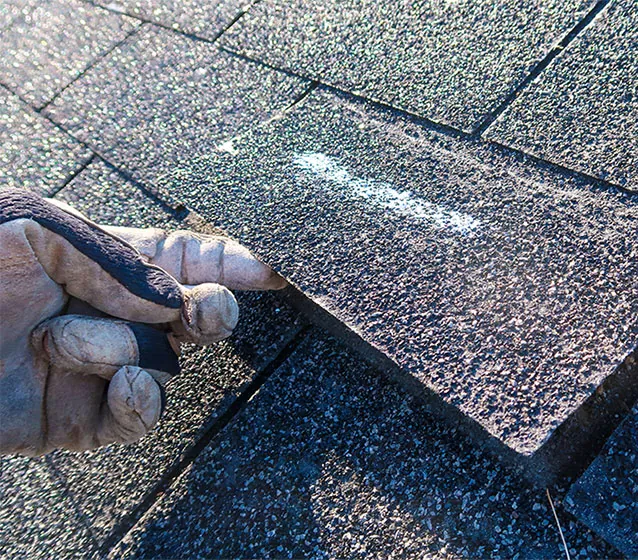
Then look at what you can see of the roof, with binoculars if you have them. IBHS lists a random pattern of impact marks, cracked shingles and soft, bruised spots (something a roofer checks by hand) as signs of hail, and notes that ridge caps are especially vulnerable. It also lists look-alikes: granule loss along shingle edges from normal weathering, uniform wear, manufacturing defects and tool marks. Heavy rain alone can knock granules loose.
Wind leaves different clues. Look for shingles or pieces of shingle in the yard, bare spots where tabs are missing, tabs that look lifted or creased along the edges and ridge, and flashing that has pulled loose. Wind damage often shows from the street, because whole pieces go missing.
Check the rest of the house too. The National Severe Storms Laboratory (NSSL) notes that wind-driven hail can tear up siding and break windows. Note any gutters that are dented or pulling away, since they are part of the same storm damage (see gutters and downspouts).
Inside, look for new water stains on ceilings and in the attic. Our guide to hail damage roof signs goes deeper.

Photograph the damage and pin down the date
DCI recommends taking photos or video of the damaged areas and jotting down notes about what you see. Take wide shots of each side of the house, then close-ups of anything dented, cracked or torn. If you can, photograph a hailstone next to a ruler or a coin: NSSL says a ruler measurement is the best way to report hail size, and a quarter is 1 inch.
Write down the date, the time and how long the storm lasted. Later, NOAA's Storm Events Database can back you up. It holds National Weather Service storm records by county and date, people rely on it for insurance and legal work, and NOAA's National Centers for Environmental Information will certify a report on request.
Those records post a few months after the storm: on October 2, 2026, the database ran through June 2026. For the days right after a storm, the Storm Prediction Center's storm reports page lists preliminary hail, wind and tornado reports, with hail sizes in hundredths of an inch. Take a screenshot while it is fresh.
Here is what a database entry can tell you. On May 13, 2023, it records hail up to 3 inches across St. Peters, Harvester and St. Charles, mainly along and east of Jungermann Road. NSSL notes that hail falls in swaths that can run from a few acres up to 10 miles wide and 100 miles long, so damage can vary from one street to the next.
That is one reason not to measure your roof by your neighbor's. DCI points out that two settlements can differ even when the damage looks the same, because coverage, deductibles and policy limits differ from one policy to the next.
Protect the house from more water
Stopping further damage is part of your job after a loss. DCI says to make temporary repairs, such as covering a hole in the roof with a tarp, because further damage will likely not be covered otherwise. Keep receipts for materials so you can be reimbursed.
Hold off on permanent repairs. DCI warns that if you make them before your insurer inspects, your claim might be denied. Meanwhile, move belongings away from leaks and catch drips inside.
If a contractor does emergency tarping, get the price in writing. Under Missouri law, if you later cancel a roofing contract tied to an insurance claim, the contractor can still charge the reasonable value of emergency work you acknowledged in writing.
If the damage is bad enough that you cannot stay in the house, DCI notes that most homeowners policies pay additional living expenses, such as a hotel, after a covered loss. That coverage has limits, so keep every receipt. Missouri's attorney general adds that price gouging on necessities like hotel rooms, gasoline and generators during an emergency is illegal, and the office takes reports at 800-392-8222.
Call your insurance company
Call your agent or your insurer's claims line as soon as you know there is damage. DCI suggests having your policy number handy and asking for:
- Your claim number, and the name and phone number of everyone you talk to
- How long you have to file the claim
- Whether you have a separate deductible for wind or hail
- When to expect the adjuster, and what else the company will need
Can't find the number? DCI's severe weather page lists claim phone numbers for major home insurers in Missouri, and it notes that some companies set up mobile claims units in areas hit hard by storms. Write everything down as you go; DCI's guide includes a simple claim log for exactly that.
If the damage looks minor, compare it to your deductible before you file. DCI notes that you might not be able to see all the damage, which is one reason to get an inspection. Missouri regulations require insurers to acknowledge a claim within 10 working days, and our Missouri roof insurance claim guide covers the rest of the process.
Your insurance company sends and pays its own adjuster. DCI says to make sure the adjuster shows identification and that you should not be asked for any payment. A public adjuster is different: a state-licensed professional you can choose to hire, paid from part of your settlement, and DCI says you do not need one to file a claim.
Get an inspection, and sign nothing at the door
After a big storm, expect knocks on the door. Be polite and take a card, but do not sign anything that day. Missouri's attorney general says to be wary of any contractor who comes to your home to solicit work or rushes you, and that if an offer is only good for a limited time, you should find someone else.
DCI also warns not to let contractors inspect your home unless you are watching, because some dishonest ones cause damage to drive up the repair cost. Missouri law adds protection: a contractor may not pay or rebate your deductible or negotiate your claim for you. A contract to be paid by insurance can also be cancelled within five business days after your insurer says in writing that the work is not covered, and the FTC's Cooling-Off Rule gives three business days to cancel many sales made at your home.
When you are ready, choose who inspects. Correll's roof inspections are free and documented with photos, and we walk you through what we found before anything else happens. No obligation, no pressure. Schedule an inspection, learn about storm damage repair, or read how to choose a roofer after a storm.
Your 48-hour checklist
- Check on everyone, and keep clear of downed lines and gas leaks.
- Walk the outside from the ground and note dents, broken windows and torn siding.
- Photograph the damage and a hailstone next to a ruler, and write down the date and time.
- Screenshot the Storm Prediction Center's preliminary reports for your area.
- Tarp or cover any openings and keep the receipts.
- Call your insurer, get a claim number and write down who you spoke with.
- Schedule an inspection with a local roofer you chose, not one who chose you.
- Sign nothing at the door.
- Thunderstorms and Lightning, Ready.gov
- Post-Disaster Claims Guide (revised September 2023), Missouri Department of Commerce and Insurance
- Resources for Severe Weather Victims, Missouri Department of Commerce and Insurance
- Is It Hail Damage?, Insurance Institute for Business & Home Safety
- Severe Weather 101: Hail, NOAA National Severe Storms Laboratory
- Storm Events Database, NOAA National Centers for Environmental Information
- About the Storm Events Database, NOAA National Centers for Environmental Information
- Storm Reports, NOAA Storm Prediction Center
- Section 407.725, Work and services for insured persons, Missouri Revisor of Statutes
- 20 CSR 100-1, Improper or Unfair Claims Settlement Practices, Missouri Code of State Regulations
- Natural Disasters consumer alert, Missouri Attorney General
- Buyer's Remorse: The FTC's Cooling-Off Rule May Help, Federal Trade Commission