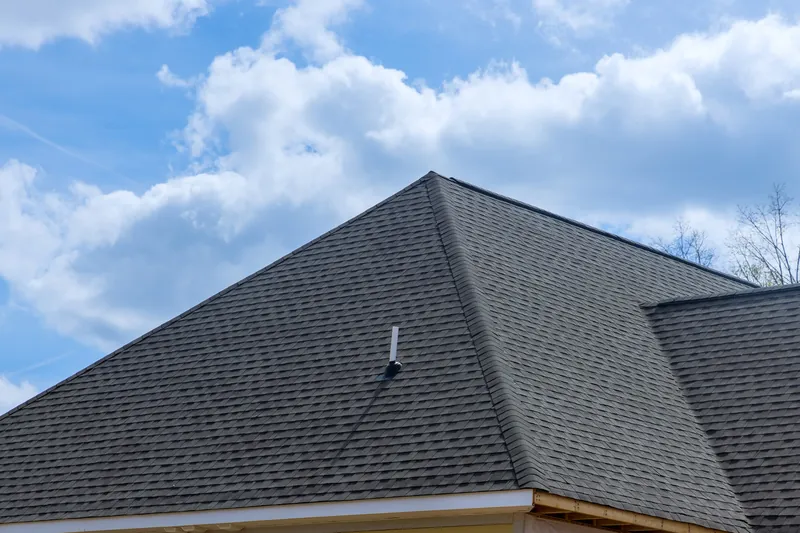
Hail does its damage in seconds, but on an asphalt roof the evidence can be as small as a dime and as quiet as a soft spot under your thumb. If a leak follows, it may not show up until a hard rain months later.
Hail is a regular visitor here. NOAA's Storm Events Database lists 94 hail reports in St. Charles County from 2015 through June 2026, and 86 of them were 1 inch or larger. This guide walks through what hail does to each part of a house, which sizes matter, and when it is worth getting a closer look.
- On asphalt shingles, hail damage means a bruise, puncture or tear in the shingle mat, usually with granules knocked off the spot. Scuffs, blisters and curling from age are different problems.
- Field studies put the damage threshold at about 1 inch for 3-tab shingles and 1.25 inches for laminated shingles. Older, thinner roofs give way first.
- Dents in gutters, vents and air conditioner fins tell you the hail's size and direction. They are clues, not a verdict on the roof.
- Much of the damage cannot be seen from the yard. Get the roof inspected before you file a claim or sign with any contractor.
How hail damages an asphalt shingle
An asphalt shingle is a mat of fiberglass (or organic felt, on older roofs) coated in asphalt and surfaced with ceramic-coated stone granules. Engineers at Haag Engineering describe the granules as the layer that gives a shingle its color and shields the asphalt from the sun. By weight, a shingle is roughly one-third granules, one-third asphalt and one-third filler.
Haag defines functional hail damage to asphalt shingles as punctures, tears or fractures in the mat. The fracture is what roofers call a bruise.
Bruises
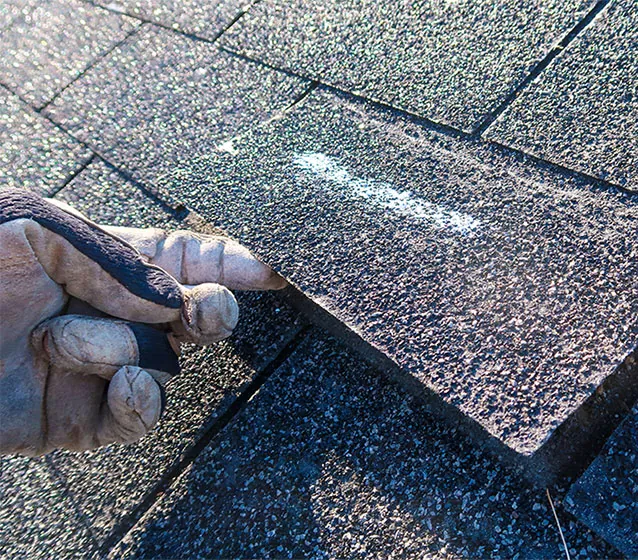
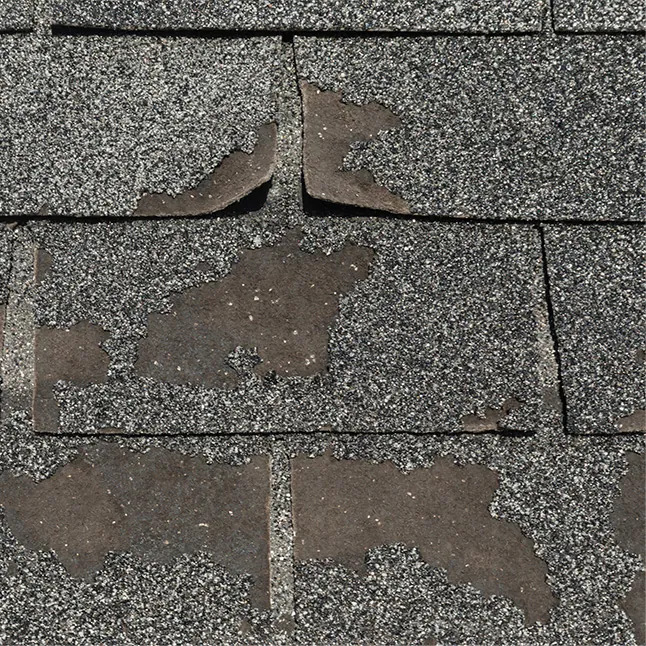
A bruise is a dent with a crack in the mat underneath. Haag's engineers compare it to a bruise on an apple because it feels soft when pressed. Most bruises also lose granules at the point of impact, leaving a dark spot of exposed asphalt.
Fresh hits look black. Over several months in the sun, exposed asphalt oxidizes to a gray film, which is one way an inspector tells new damage from old.
Punctures, torn edges and broken corners
Larger hail can punch through a shingle, tear its exposed edge or snap off a corner. Shingles with little support underneath are the most vulnerable, especially along ridges, rakes, eaves and valleys. The slopes facing the storm usually take the most direct hits, while the far side gets glancing blows.
Granule loss
Granule loss is where the experts disagree. Every shingle sheds granules over its life, and Haag's 10-year field study found that new shingles carry extra: 12 to 15% of the surface granules had to be removed before the mat showed. Test shingles in that study kept shedding water even with 70% of their granules gone.
The Insurance Institute for Business and Home Safety (IBHS) sees a slower cost. In a peer-reviewed study published in 2025, shingles hit by repeated small hail (0.7 to 1 inch) and weathered outdoors for two years became about 10 times more susceptible to damage from later large hail than new shingles. Haag has answered that the research is useful for risk modeling but should not stand in for finding actual hail ruptures when a roof is assessed after a storm.
Both points hold. Granule loss alone is not a bruise, but a roof that keeps losing granules is aging faster.
Haag's engineers list common look-alikes: small blisters (usually 1/4 inch or less) caused by heat and asphalt quality, cupping and clawing as shingles shrink with age, scuffs from people walking on hot shingles, and round bare spots where adhesive pulled granules away. These can be real problems, but they are not storm damage, and an honest inspection report says so.
What hail size starts to matter
The National Weather Service calls hail severe at 1 inch, about the size of a quarter. It raised that line from 0.75 inch on January 5, 2010. Its size chart, paired with what roofing research has found at each size, is a handy way to translate what you saw:
| Hail size | Compare to | What research says about roofs |
|---|---|---|
| 0.75 inch | Penny | Below the severe line, but repeated rounds of 0.7 to 1 inch ice, plus weathering, wore shingles down faster in IBHS tests |
| 1 inch | Quarter | Damage threshold for 3-tab shingles in Haag's field surveys |
| 1.25 inches | Half dollar | Threshold for 30-year laminated shingles and cedar shingles |
| 1.5 inches | Ping pong ball | Threshold for medium cedar shakes and fiber-cement tiles; dents showed up on metal roofs at this size in one Oklahoma City study |
| 1.75 inches | Golf ball | Threshold for concrete tile |
| 2 inches and up | Hen egg, tennis ball, baseball | Every product in Haag's lab tests was damaged at least some of the time by 2-inch ice |
Size matters because impact energy climbs steeply. In the energy table Haag's engineers worked from, a 1-inch stone falls at about 50 mph and strikes with less than 1 foot-pound of energy. A 2-inch stone falls at about 72 mph and hits with about 22 foot-pounds, and a 3-inch stone falls at about 88 mph and hits with about 120 foot-pounds.
Size is not the whole story, though. Haag lists the stone's shape, hardness, speed and angle, plus the roof's age, support and temperature, as reasons results vary. In Haag's lab work, 11-year-old organic 3-tab shingles broke half the time under 1-inch ice, while aged laminated shingles held until 1.5 inches. Lighter, thinner and older roofs fail first.
Shingles sold as impact resistant are tested under UL 2218, which drops steel balls from 1.25 inches (Class 1) to 2 inches (Class 4) onto the same spot twice. Our impact-resistant shingles guide covers what that rating does and does not promise.
Metal roofs, gutters, vents, siding and screens
Soft metal shows hail more plainly than shingles do. That makes the rest of the house a useful gauge, so walk around it before anyone climbs a ladder.
- Metal roofs. Panels lie flat on the deck, so hail tends to dent them without breaking them. InterNACHI notes that hail seldom causes functional damage to metal panels, but it can distort metal shingles until their interlocking seams leak. In a field review of six metal roofs after a 2004 Oklahoma City hailstorm, reported by consultants Koontz and White, dents appeared where hail was 1.5 inches or larger and were cosmetic, with paint and metal coating intact.
- Gutters and downspouts. Look for small dents and dimples along the face and top edge, and for piles of granules at downspout outlets.
- Roof vents and caps. These are often thin metal or plastic. Dents or cracks here are a sign the roof took heavy hail.
- Siding. Check for spatter marks, dents, cracks, chipped paint and holes, especially on walls that faced the storm. Cracked panels are a job for siding repair.
- Window screens and sills. Hail can tear or punch holes in metal and fiberglass screen mesh and leave dings in sills and casings.
- Air conditioner and other metal. Dented condenser fins and spatter marks on faded metal, like electrical boxes, help estimate the size and direction of the hail.
Haag's point is that these clues should line up with the roof. If the screens on the west side are torn, the west-facing slopes deserve the closest look.
Why you often cannot see it from the ground
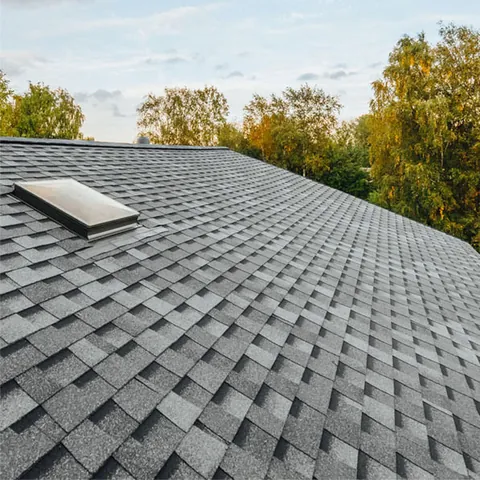
A bruise is a crack beneath an intact layer of granules, and many are found by pressing on the shingle rather than by looking at it. From the yard, a dime-sized dark spot on a dark shingle simply disappears. Missouri's Department of Commerce and Insurance makes the same point in its claims guide, noting that you might not be able to see all the damage and may want a contractor to inspect.
Damage also hides in the pattern. It clusters on the slopes that faced the storm and along edges, so a careful inspector checks every slope. One method Haag has published marks a test square on each slope, counts the damaged shingles inside it and uses that count to decide repair or replacement slope by slope.
You can look from the ground or an upstairs window with binoculars, as the Asphalt Roofing Manufacturers Association (ARMA) suggests. Leave the climbing to a roofer. ARMA's advice to homeowners is not to climb on the roof at all, because it is dangerous and can damage the shingles.
When to call for an inspection
Call for a roof inspection after a storm if any of these apply:
- Hail of 1 inch or larger was reported near you. NOAA's storm reports are public, and your neighbors' gutters tell the same story.
- Gutters, downspouts, vents or air conditioner fins have new dents.
- You find piles of granules at downspout outlets or pieces of shingle in the yard.
- A ceiling, a wall or the underside of the roof deck shows a new water stain after rain.
- A stranger knocks on your door to say your roof is damaged. Get your own inspection before you sign anything.
While you wait:
- Photograph damage to the house, cars and belongings before you clean up, as the Missouri Department of Commerce and Insurance recommends.
- Cover any opening with a tarp to keep water out, and keep receipts for materials.
- Read your policy for deadlines to report damage and for how it pays on roofs. The department notes that some policies pay depreciated value on the roof even when the rest of the house has replacement cost coverage.
- Be wary of strangers offering repairs, and do not pay the whole bill in advance. Our guide to choosing a roofer after a storm covers what to ask.
Two other guides go further. For the full sequence, see what to do after a hailstorm and our Missouri roof insurance claim guide.
How a hail inspection works with Correll
A free inspection from Correll Roofing Co. covers the roof and the rest of the exterior, with photos and notes. We show you what we found, photo by photo, before anything else happens. If there is storm damage worth claiming, we help you call in the claim, meet your adjuster at the property to point out the damage we documented, and go over the adjuster's scope with you line by line. If the photos show no damage worth claiming, you see that too, with no obligation and no pressure.
The claim stays yours. Missouri law (RSMo 407.725) does not let roofers represent or negotiate for homeowners on insurance claims, or promise to pay or rebate a deductible. If you sign a roofing contract that is to be paid from an insurance claim, the same law lets you cancel it before midnight on the fifth business day after your insurer tells you in writing that all or part of the claim is not covered.
Start with a roof inspection, or contact us to set a time. You can also read about storm damage repair and insurance claim help.
- Hail Damage Threshold Sizes for Common Roofing Materials, Haag Engineering (American Meteorological Society, 21st Conference on Severe Local Storms)
- Hail Damage to Asphalt Roof Shingles, Haag Engineering (American Meteorological Society Annual Meeting, 2004)
- Why IBHS Sub-Severe Hail Research Shouldn't Guide Forensic Damage Assessments, Haag
- Sub-severe hail: the missing piece in assessing asphalt shingle risk in North America, Frontiers in Materials (IBHS researchers, 2025)
- Impact Testing of High Concentrations of Small Hail, Insurance Institute for Business and Home Safety
- Severe Thunderstorm Reference Table (Hail), National Weather Service La Crosse
- Service Change Notice 09-52 on the 1-inch hail criterion, National Weather Service
- NOAA Storm Events Database, NOAA National Centers for Environmental Information
- Hail Damage on Coated Sheet Steel Roofing, U.S. Steel
- The Effects of Hail on Metal Roofing Systems, Koontz and White (IIBEC)
- Mastering Roof Inspections: Metal Roofs, Part 10, InterNACHI
- Checklist to Spot Roof Hail Damage, Texas Association of Counties
- Section 407.725, Revised Statutes of Missouri, Missouri Revisor of Statutes
- Post-Disaster Claims Guide, Missouri Department of Commerce and Insurance
- Storm recovery guidance for Missourians (July 2026), Missouri Department of Commerce and Insurance
- Guidance for Missouri consumers affected by storms, Missouri Department of Commerce and Insurance
- Frequently Asked Questions, Asphalt Roofing Manufacturers Association
- Spring Roof Inspection a Must for Property Owners, Asphalt Roofing Manufacturers Association