Hail is a routine part of roofing in the St. Louis area, so when it is time to replace a roof, many homeowners ask about Class 4 impact-resistant shingles. They can be a smart upgrade. They are also easy to oversell.
The rating comes from a laboratory test on new material, and it measures one kind of damage. Here is what it does and does not tell you, how it lines up with the hail that actually falls here, and how insurance fits in.
- Class 4 is the top rating under two tests: UL 2218, which drops steel balls up to 2 inches across, and FM 4473, which fires ice balls up to 2 inches. Both test new material.
- About 90% of NOAA hail reports in St. Charles County, St. Louis County, the City and Jefferson County since 2015 were 1.75 inches or smaller, but hail of 2 inches or more fell on 15 different days.
- IBHS research shows rated shingles vary widely, and that weathering and small hail leave any shingle more vulnerable over time.
- Missouri law does not require insurers to discount impact-resistant roofs. Ask your agent what yours offers and on what terms.
How the impact tests work
Impact ratings for roofing come from two standards, UL 2218 and FM 4473. Each sorts products into Classes 1 through 4 by the size of the projectile they withstand. The Insurance Institute for Business & Home Safety (IBHS) counts a shingle as impact-rated if it carries a Class 3 or 4 rating under either one.
UL 2218 is a steel ball drop test. Balls of 1.25, 1.5, 1.75 and 2 inches correspond to Classes 1 through 4, and each is dropped from the height needed to match the energy of a hailstone that size. Every test location takes two strikes. Any opening on the back of the shingle, such as a tear, fracture, crack or rupture, is a failure, while crushed or loosened granules, dents and openings visible only on top do not count against it.
FM 4473 uses ice balls of the same four sizes, launched to match the energy of falling hail. FM Approvals first issued it in 2005, and it has been an American National Standard since 2011. Each target spot is hit twice within half an inch, and the sample fails with any visible cracking, splitting, puncture or breakage.
FM wrote its test for rigid roofing such as slate, concrete and clay tile. The standard notes that ice balls are generally harder and denser than real hailstones, so they simulate a worst case.
What a Class 4 rating does not prove
A rating is a pass on a standardized test, not a promise about your roof in a real storm. Keep these limits in mind:
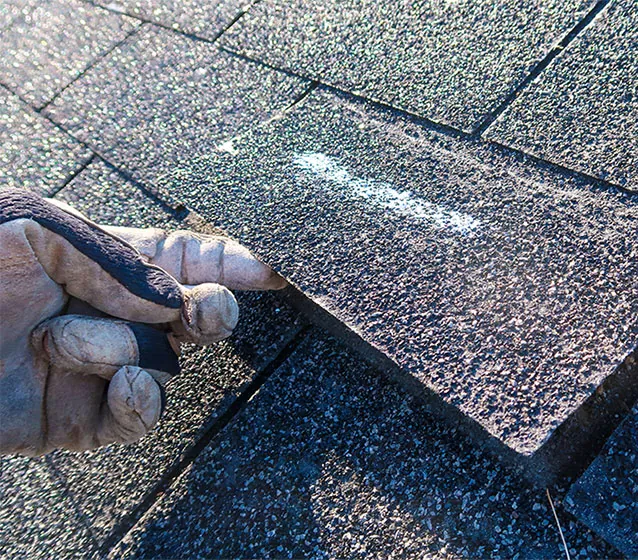
- Cosmetic damage is not scored. Under UL 2218, granule loss and dents on the top surface are not failures. IBHS notes that the test's pass criteria do not necessarily match how insurers decide whether to repair or replace a roof after hail.
- The tests use new material. The FM 4473 standard itself says long exposure to the elements has the potential to significantly lower a roof's hail resistance, and IBHS's own ratings are based on new, unaged shingles.
- Small hail adds up. In IBHS testing, shingles exposed to weathering and two rounds of sub-severe hail (under 1 inch) became up to 10 times more susceptible to damage from later large hail than new shingles. IBHS says current standards do not test durability over time or different concentrations of hail.
- Rated shingles are not all alike. When IBHS ran UL 2218 tests in its own lab on 22 shingle products bought off the shelf in 2013, none of them, rated or not, got through impacts larger than Class 2 without at least one failed location. Products have changed since then, and IBHS now publishes ratings it updates as products are retested.
What IBHS found when it tested shingles like real hail
IBHS runs a hail lab that fires laboratory-made hailstones, 1.5 and 2 inches across, at shingles bought through ordinary retail channels. Instead of pass or fail, its protocol scores dents, tears and granule loss. Its 2020 summary of results found:
- Against 1.5-inch laboratory hail, every product tested rated Good or Excellent. In new condition, both impact-rated and standard shingles should offer good protection from hail that size or smaller.
- Against 2-inch hail, differences showed up. Where a manufacturer's impact-rated shingle beat its standard one, the Good and Excellent impact-rated products scored 14% higher on average, and as much as 34% higher for some products.
- Every impact-rated shingle that earned Good or Excellent at 2 inches was made of polymer-modified asphalt.
- Dents and ridges were the weakest scores across the board, and they are among the damage types most directly tied to leaks.
IBHS posts its current product ratings online and retests rated products every two years. Ask any roofer you interview how the shingles they propose scored, not just whether the wrapper says Class 4.
The hail St. Louis actually gets
The National Severe Storms Laboratory (NSSL) uses everyday objects for scale. A quarter is 1 inch, the size at which hail counts as severe. A ping-pong ball is 1.5 inches, a golf ball 1.75, a tennis ball 2.5, a baseball 2.75 and a softball 4.
From January 2015 through June 2026, NOAA's Storm Events Database logged 384 hail reports in St. Charles County, St. Louis County, the City of St. Louis and Jefferson County. Roughly half were exactly 1 inch, and 347 of them, about 90%, were 1.75 inches or smaller. But 37 reports of 2 inches or larger came on 15 separate days, including:
- May 11, 2016: hail up to 4 inches across St. Charles County, worst from near Dardenne Prairie, O'Fallon and Weldon Spring east to Cottleville and St. Peters.
- May 13, 2023: hail up to 3 inches in St. Peters, Harvester and St. Charles, mainly along and east of Jungermann Road.
- March 14, 2024: hail up to 3 inches along the I-70 corridor in western St. Charles County.
- May 26, 2024: hail up to 2.75 inches in St. Peters and St. Charles.
- May 16, 2025: hail of 2 to 2.5 inches, with 30 reports in St. Charles County and 34 in St. Louis County.
Size matters more than it sounds. NSSL estimates that hail of 1 to 1.75 inches falls at about 25 to 40 mph, while stones of 2 to 4 inches fall at 44 to 72 mph.
A Class 4 shingle is tested at the top of the range most local storms produce. In IBHS testing, new standard and impact-rated shingles both held up well at 1.5 inches, and the better impact-rated ones pulled ahead at 2 inches. No shingle is built for the hail of 3 to 4 inches that the worst days bring.
What impact-resistant shingles cost
The clearest published comparison comes from IBHS. In its 2020 cost survey across seven U.S. markets, shingles with Good or Excellent IBHS ratings cost 9% more per square (100 square feet of material) on average than shingles without an impact rating. The gap varied: only 2% in Oklahoma City and 4% in Dallas and Fort Worth, but wider in the Southeast and Mid-Atlantic, where these products were harder to find.
That survey priced material, not the whole job. For scale, the 2024 Cost vs. Value report put a standard 30-square asphalt tear-off in the St. Louis market at $24,226, a third-party estimate rather than anyone's quote. The surest way to see the difference on your house is an estimate that prices both shingles on the same roof, and our roof replacement cost guide covers the rest of the math.
Metal is the other common upgrade, at a higher price: $38,516 for the same defined roof in that 2024 St. Louis figure. Read the asphalt vs. metal guide, and check how your policy treats cosmetic hail damage on metal before you decide.
The insurance angle in Missouri
Some insurers give premium credits for impact-resistant roofs, but in Missouri it is up to the insurer. As of October 2026, a full-text search of the Revised Statutes of Missouri finds no requirement that insurers discount premiums for impact-resistant roofing.
The terms matter as much as the credit. The Missouri Department of Commerce and Insurance publishes roof coverage summaries for the state's 20 largest home insurers. One notes that qualified metal roofs may receive an impact-resistant roof discount if cosmetic hail damage is excluded. Others exclude purely cosmetic hail damage to metal roofing, and one applies replacement cost settlement for wind and hail at any roof age to hail-resistive metal, tile, concrete and synthetic polymer roofs.
Before you buy, ask your agent:
- Do you offer a premium credit for a Class 4 or impact-rated roof, and how much is it?
- What proof do you need, such as the product name, the label showing its UL 2218 or FM 4473 class, or the invoice?
- Does the credit come with a cosmetic damage exclusion or a different deductible?
- Would the new roof change how a future roof claim is settled, at replacement cost or actual cash value?
Get the answers in writing. Policies change, and only your insurer can say what yours will do.
Is it worth it for your house?
That depends on a few things only you can weigh:
- How long you plan to stay. The longer you own the roof, the more storms it will see.
- What your insurer offers, and what conditions come with it.
- How specific products score in IBHS testing, not just whether they carry a Class 4 label.
- Your budget for the whole job, including decking, ventilation and flashing.
Correll installs asphalt shingles, metal, slate and more, and our inspections and estimates are free. If you are weighing an upgrade, ask us to price it next to a standard shingle, or read more about roof replacement and metal roofing.
- Relative Hail Impact Resistance of Asphalt Shingles, with the August 2014 UL 2218 test summary, Insurance Institute for Business & Home Safety
- Hail Impact Performance of Asphalt Shingles, At a Glance (2020), Insurance Institute for Business & Home Safety
- Hail Impact-Resistant Shingle Ratings, Insurance Institute for Business & Home Safety
- Impact Resistance Test Protocol for Asphalt Shingles, Insurance Institute for Business & Home Safety
- Hail Impact Test Results Disclosures, Insurance Institute for Business & Home Safety
- Impact Testing of High Concentrations of Small Hail, Insurance Institute for Business & Home Safety
- ANSI/FM 4473, Impact Resistance Testing of Rigid Roofing Materials by Impacting with Freezer Ice Balls (reaffirmed 2020), FM Approvals
- Class Number 4473 test standard (July 2005 edition), FM Approvals
- Severe Weather 101: Hail, NOAA National Severe Storms Laboratory
- Storm Events Database, NOAA National Centers for Environmental Information
- 2024 Cost vs. Value, St. Louis, Missouri, Zonda and The Journal of Light Construction
- Raising the Roof on Insurance Coverage, Missouri Department of Commerce and Insurance
- Revised Statutes of Missouri, Missouri Revisor of Statutes