Ask three roofers to price the same house and you can get three different numbers. Some of that gap is overhead and workmanship. Much of it is the roof itself: how big it is, how steep it is, how many layers are on it, and what the deck underneath looks like once the old shingles come off.
This guide pulls together published figures for the St. Louis area, with their dates, and walks through each factor that moves the price. Every dollar amount below is a third-party estimate. None of them are Correll's prices.
- The 2024 Cost vs. Value report priced a standard 30-square asphalt tear-off in the St. Louis market at $24,226 and a standing-seam metal roof at $38,516.
- The 2025 edition no longer lists St. Louis. Its West North Central averages were $30,693 for asphalt and $50,520 for metal.
- Size, pitch, layers, decking, ventilation, flashing and material move the price more than anything else.
- On a storm claim, your deductible, depreciation and code-upgrade coverage decide what you pay out of pocket.
What published cost reports say
A widely cited yardstick is the Cost vs. Value report, published by Zonda through The Journal of Light Construction. It prices the same defined projects in each market using estimating data from Verisk's XactRemodel, then asks more than 6,000 real estate agents how much value each project adds at resale. The 2025 edition came out September 18, 2025.
Both roofing projects in the report assume a rectangular hip roof of 3,000 square feet (30 squares) with two skylights, torn off to the bare wood deck. The asphalt version uses fiberglass shingles over felt or synthetic underlayment, with new drip edge and aluminum flashing. The metal version uses prefinished standing-seam panels over an ice barrier at the edges and premium synthetic underlayment.
- St. Louis, 2024 report: asphalt shingles $24,226, with a resale value of $11,962 (49.4% of cost recouped). Metal $38,516, with a resale value of $15,521 (40.3%).
- West North Central region, 2024 report: asphalt $26,824. Metal $43,987.
- West North Central region, 2025 report: asphalt $30,693 (54.2% recouped). Metal $50,520 (44.6% recouped).
- National average, 2025 report: asphalt $31,871 (67.5% recouped). Metal $51,865 (50.1% recouped).
The 2025 edition dropped St. Louis from its West North Central markets (Kansas City is the only Missouri city left), so the 2024 figures are the newest local ones. Divided by 30 squares, the 2024 St. Louis asphalt figure works out to about $808 per square. Treat that as a rough yardstick for a simple roof, not a quote.
Size: roofs are priced by the square
Roofers measure in squares. A square is 100 square feet of roof surface, so the report's 3,000-square-foot roof is 30 squares. Because a roof slopes and hangs past the walls, its surface is larger than the footprint of the house, which is why a good estimate starts with measuring the roof itself.
Shape matters too. Hips, valleys, dormers and short runs mean more cutting, more waste and more flashing than a plain gable with the same area. Two houses with the same square footage inside can have very different roofs over them.
Pitch, layers and the deck underneath
Pitch. A steep roof takes longer to work safely and needs more setup, so it costs more to cover.
Low slopes have their own code limits. The City of O'Fallon's re-roofing guide, which is based on the International Residential Code, does not allow asphalt shingles below a 2:12 slope. It calls for two layers of underlayment from 2:12 up to 4:12 and one layer at 4:12 and steeper.
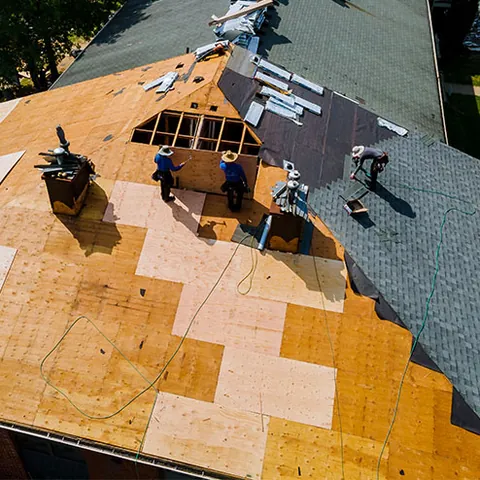
Layers. Every extra layer of old roofing means more labor and more disposal. O'Fallon's guide requires all existing layers to come off down to the sheathing, with one exception: a single existing layer that, along with the deck below it, is still an adequate base and is not deteriorated or water-soaked. The guide is dated May 2017 and the city notes the information is subject to change, so confirm your own city's current rule before anyone proposes a recover.
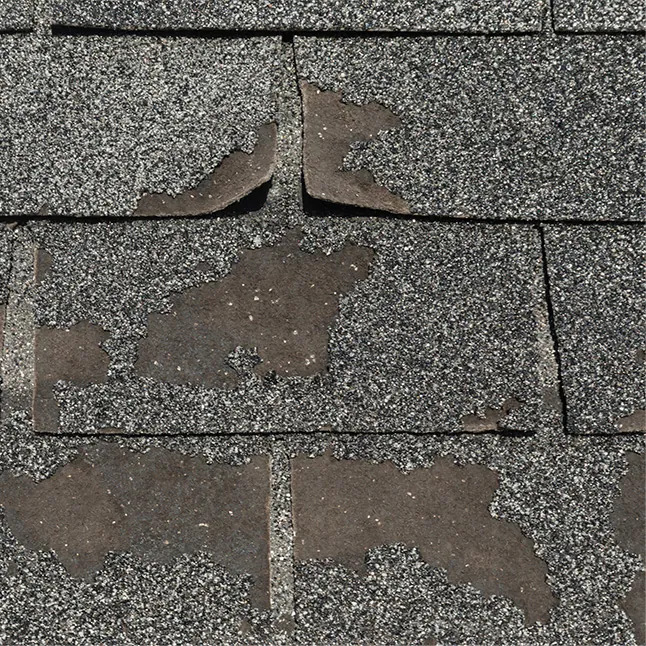
Decking. Shingles have to be nailed to a solid deck. Under O'Fallon's guide, sheathing that is deteriorated, warped, cracked or delaminated is not a proper base, and a deck of boards with gaps wider than 1/2 inch needs a layer of 3/8-inch panels over it.
Nobody can see rotted decking until the shingles are off. Ask how replacement sheets are priced before you sign, so a soft spot does not turn into a surprise.
Ventilation, flashing and other line items
Ventilation. O'Fallon's guide says a re-roof may not reduce or block the attic ventilation a house already has, and shingle makers' installation instructions may require more. For new construction the code calls for 1 square foot of vent opening per 150 square feet of attic, or 1 per 300 when the vents are split between high exhaust and low intake as the code describes. If your soffits need vents to make that work, see soffit and fascia.
Flashing and edges. The same guide requires drip edge at the eaves and rakes, step flashing where the roof meets a wall, and lined valleys. Old flashing can stay only if it is in good condition and is reworked to the manufacturer's instructions. Chimneys and skylights call for custom flashing, and the Cost vs. Value price includes custom flashing at two skylights.
Underlayment. O'Fallon's guide also notes that underlayment meeting the current code has to go on during a re-roof, even if the old roof never had any. That is one way a code update shows up on an estimate.
Material: asphalt, impact-resistant or metal
In the 2024 St. Louis figures, the metal roof cost about 59% more than asphalt for the same defined roof. It also recovered a smaller share of its cost at resale in every set of figures listed above. Whether metal pays off for you depends on how long you plan to stay and what you want from the roof. Our asphalt vs. metal guide covers the tradeoffs.
Impact-resistant shingles sit in between. In a 2020 survey across seven U.S. markets, the Insurance Institute for Business & Home Safety (IBHS) found that shingles earning its Good or Excellent hail ratings cost about 9% more per square in materials, on average, than shingles without an impact rating. Our impact-resistant shingles guide explains what that premium buys and what it does not.
How insurance changes the math
If hail or wind damaged the roof, your out-of-pocket cost depends less on the contractor's price and more on your policy. The Missouri Department of Commerce and Insurance (DCI) lays out the moving parts in its Post-Disaster Claims Guide.
Deductible. It may be a flat amount or a percentage of your dwelling coverage, and some policies carry a separate wind and hail deductible or one that applies only to the roof. In DCI's example, a 2% deductible on a home insured for $250,000 is $5,000.
Depreciation. Replacement cost coverage pays to repair or replace without subtracting depreciation. Actual cash value coverage subtracts it.
DCI's example uses two identical $15,000 roofs, both 10 years old, each with a $1,000 deductible. The replacement cost policy pays $14,000. The actual cash value policy, depreciating the roof $1,000 a year, pays $4,000.
Recoverable depreciation. Many replacement cost policies pay actual cash value first, then release the held-back depreciation once you show the work is done. DCI says the time limit to collect it typically runs six months to two years, depending on state law and your policy.
Roof age. DCI publishes roof coverage summaries for the 20 largest home insurers in Missouri. Several of them switch roofs to actual cash value settlement after a set age, with cutoffs from 11 to 16 years depending on the company and the roofing material. One summary says the company pays to replace only one layer when a house has more than one.
Code upgrades. Standard homeowners policies do not pay the added cost of bringing a roof up to current code. Ordinance and law coverage does, up to its limit, so look for it on your declarations page.
Upgrades. Policies generally pay for "like kind and quality." If you choose a better shingle or switch to metal, expect to pay the difference yourself.
This guide explains how claims usually work. It is not insurance advice. Your policy, your declarations page and your agent decide what is covered. For the full claim process, see our Missouri roof insurance claim guide.
How to get estimates you can compare
DCI suggests getting estimates from more than one contractor, with materials, prices and labor shown line by line, and warns that a bid far below the others is not automatically the best deal. The Better Business Bureau adds that a roofing proposal should name the shingle, manufacturer and color, list the underlayment and flashing work, and say who hauls away the old roof.
When you line estimates up, check that each one covers the same things:
- Roof size in squares and the number of layers coming off
- How decking replacement is priced, by the sheet or by the square foot
- Underlayment type, drip edge, starter, ridge cap and valley treatment
- Flashing at walls, chimneys and skylights
- Ventilation, including any new ridge or soffit vents
- Permits where your city requires them, plus cleanup and disposal
- Manufacturer warranty registration, and the contractor's workmanship terms in writing
Correll gives free roof inspections and free estimates. We document what we find with photos and walk you through it before anything else happens. No obligation, no pressure.
The old shingles we tear off are recycled. When you are ready, request an inspection or read more about roof replacement.
- 2024 Cost vs. Value, St. Louis, Missouri, Zonda and The Journal of Light Construction
- 2025 Cost vs. Value, West North Central region, Zonda and The Journal of Light Construction
- Roofing Replacement, Asphalt Shingles (project description), The Journal of Light Construction
- Roofing Replacement, Metal (project description), The Journal of Light Construction
- 2025 Cost vs. Value methodology, The Journal of Light Construction
- Zonda's 38th annual Cost vs. Value report (September 18, 2025), PR Newswire
- Residential Re-roofing Requirements (May 2017), City of O'Fallon
- Building and Permits, City of O'Fallon
- Hail Impact Performance of Asphalt Shingles, At a Glance (2020), Insurance Institute for Business & Home Safety
- Post-Disaster Claims Guide (revised September 2023), Missouri Department of Commerce and Insurance
- Raising the Roof on Insurance Coverage, Missouri Department of Commerce and Insurance
- BBB Tip: Hire a trusted roofing contractor to repair, replace roof, Better Business Bureau