Most roofs give plenty of warning before they fail. The hard part is telling a roof that needs a repair from one that is worn out, especially when the advice comes from someone who would also sell you the new roof.
This guide covers the signs you can check from the yard and the attic and what each one usually means. It also covers the cases where a repair is the honest answer.
- Age sets expectations: about 20 years for 3-tab shingles and 30 for architectural shingles, by InterNACHI's estimates.
- Widespread curling, bald patches and leaks in more than one place point to replacement.
- Daylight through the roof deck or a sagging roofline calls for a professional look soon.
- The building code does not allow a new layer over two or more existing layers.
- A leak at one flashing, or a few shingles lost to wind on an otherwise sound roof, is usually a repair.
Start with the roof's age
InterNACHI's life expectancy chart puts 3-tab shingles at about 20 years and architectural shingles at about 30. The Asphalt Roofing Manufacturers Association (ARMA) is blunter: in its FAQ, any residential roof more than 20 years old is a prime candidate for reroofing. Around St. Louis, summer heat, hail and attic ventilation can pull those numbers down, as our guide to how long a roof lasts explains.
If you do not know the roof's age, check your closing documents, ask the previous owner or look for old receipts. Age alone does not condemn a roof, but it tells you how to read everything else. A curled shingle on a 25-year-old roof means something different from a curled shingle on a five-year-old roof.
Signs on the shingles
You can check most of these from the ground or an upstairs window. ARMA suggests using binoculars, and its advice to homeowners is not to climb on the roof.
Curling, cupping and clawing
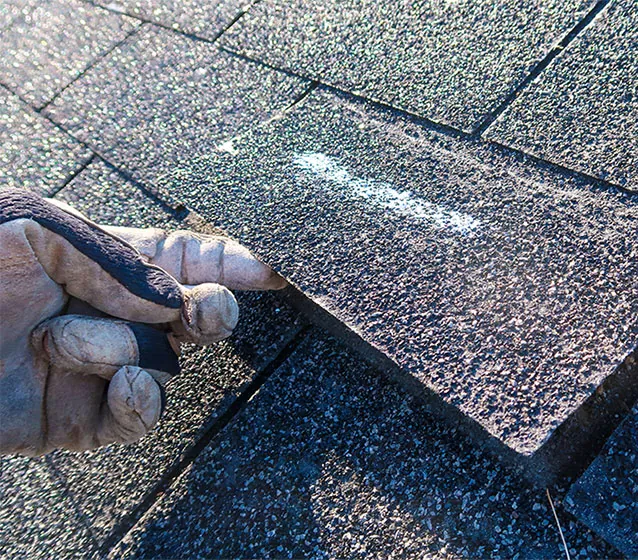
As asphalt shingles age, the asphalt shrinks. Haag Engineering's researchers explain that cupping and clawing come from that shrinkage on the top and bottom surfaces of the shingle: cupped shingles turn their edges and corners up, and clawed shingles hump in the middle. Curled edges stand up where wind can get under them. A few curled tabs over a gutter are worth watching; curling across whole slopes is a roof near the end.
Granule loss and bald spots
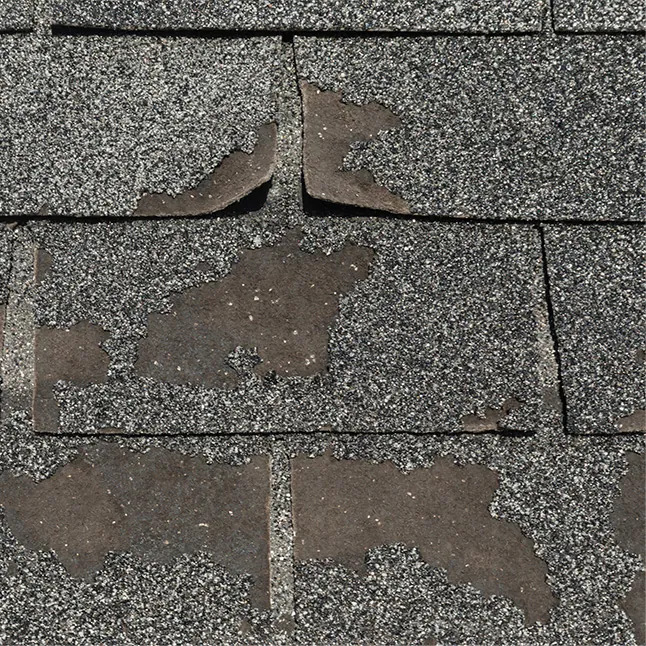
Some granule loss is normal. New shingles carry extra granules, and Haag's researchers note that shedding starts at the factory and continues for the life of the roof. What signals the end is crazing and flaking, where chunks of granules come away and leave the asphalt-coated mat exposed.
Look for dark, bald patches on the shingles and steady piles of granules at the downspouts. Never pressure wash a shingle roof to clean it, because ARMA warns that it causes granule loss and very likely premature failure.
Missing, cracked or creased shingles
A few shingles lost in a strong wind, on a roof with years left, is a routine repair. On an older roof, new shingles may not match the weathered ones, which is a cosmetic issue, not a leak. Repeated losses after ordinary storms are a sign to have the whole roof evaluated rather than patched again.
Blisters and buckles
Small blisters, usually 1/4 inch or less, come from asphalt quality and heat, Haag notes. They are an aging issue, not storm damage.
Buckled shingles that form ridges or waves are a different signal. ARMA's technical bulletin traces most buckling to wrinkled underlayment or a roof deck that moves as it takes on moisture, and names poor attic ventilation as a contributor. A buckling pattern that follows the seams of the deck points to the deck and attic rather than the shingles, and it needs a professional look.
Streaks and moss
Dark streaks across a roof are usually algae. ARMA says it has found no scientific evidence that algae damages asphalt shingles, so streaks alone are not a reason to replace a roof, and algae-resistant shingles are an option whenever you do. Moss is different, because ARMA says it can lift shingle edges, which raises the risk of blow-off, and send water sideways into the deck. Have moss removed gently by a professional and trim back the branches that keep the roof shaded and damp.
Signs inside the attic
The attic shows what the yard cannot. Go up on a dry day with a good flashlight, step only on the framing, and wear a respirator, as InterNACHI recommends for attic work.
Look for:
- Daylight through the roof deck. InterNACHI's rule of thumb is that if you can see out, water may be able to get in. Older wood shake roofs are the exception, since some light through shakes is normal.
- Water stains and dark wood. Stains on the underside of the decking mark past or present leaks, and dark staining on decking or rafters points to long-term moisture.
- Rusty nail tips and damp insulation. Both say moisture has been a persistent problem, from leaks or from poor ventilation.
- Sagging. Sagging decking or rafters is easier to spot from underneath. InterNACHI's guidance is that sagging rafters call for stabilization by a qualified contractor.
- Blocked vents. Insulation stuffed against the soffit vents, or bathroom fans that vent into the attic instead of outdoors, trap moisture that leads to rot.
Daylight or sagging moves a roof to the top of the list. So does a sagging roofline you can see from the street.
Leaks that keep coming back
One leak is a repair. A pattern of leaks is a verdict.
ARMA calls flashings the most vulnerable points on a roof, and the 2021 International Residential Code requires flashing wherever a roof meets a wall, changes slope or direction, or wraps an opening such as a chimney, vent or skylight. A leak at one of those spots, on a roof with life left, is usually fixed by repairing or replacing that flashing.
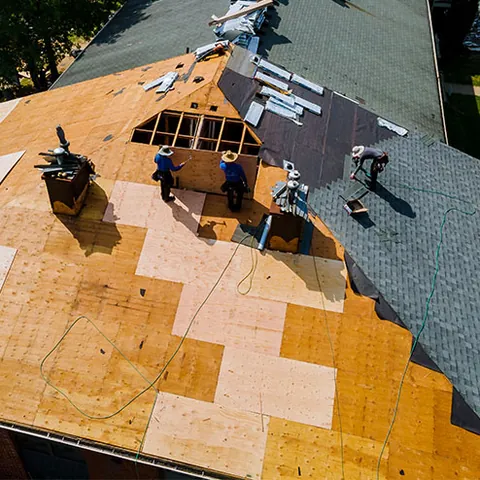
Leaks that move around, show up in several unrelated spots, or return after repairs point to a roof that is wearing out everywhere at once. If water is coming in now, ask about emergency roof repair to stop the damage while you sort out the bigger decision.
Two or more layers already on the roof
Some older homes already have a second layer of shingles nailed over the first. Under the 2021 International Residential Code, a roof replacement removes the existing layers down to the deck, and a new covering cannot go over two or more existing layers, over a wet or deteriorated roof, or over slate, clay or cement tile. ARMA notes that some local ordinances forbid reroofing over two or more layers as well. As of 2026, St. Charles County, for example, has adopted the 2021 codes with local amendments.
You can often spot a second layer at the roof edge, where the shingle ends look thick or doubled. If there are two layers, the next roof is a tear-off, and the decking underneath finally gets a look.
Questions to ask before you decide
Whoever inspects your roof, a few questions will tell you whether you are hearing a diagnosis or a sales pitch. Ask any roofer you interview:
- Can you show me photos of each problem you found, and where it is on the roof?
- Is the damage in one area, or spread across several slopes?
- How many layers are on the roof now, and what does that mean for the job?
- What will you check on the deck once the old roof is off, and how is any decking work priced?
- If you recommend a repair, how long should it hold on a roof this age?
- What manufacturer warranty comes with the materials, and what registration and installation rules apply? Please put the terms in writing.
Specific answers backed by photos are what you are looking for. Vague answers, pressure to sign on the spot or a price that changes once the old roof is off, with no photos to explain why, are reasons to get a second opinion.
When a repair is the honest answer
A good contractor will tell you when a repair will do, and show you photos either way. Repairs usually make sense when:
- The roof is well within its expected life and the problem is in one place.
- Wind took a few shingles and the rest are lying flat and sealed.
- A leak traces to one flashing, vent or chimney.
- Storm damage is limited to one or two slopes. Haag's published inspection method decides repair or replacement slope by slope for that reason.
Replacement usually makes sense when:
- The roof is at or past its expected life and showing wear on several slopes.
- Shingles are curled, bald or brittle across the roof.
- Leaks keep coming back in different places.
- The deck is soft, sagging or stained over wide areas.
- There are already two layers.
For storm damage, Missouri's Department of Commerce and Insurance suggests finding out your deductible first. For minor damage, such as a few shingles, it notes you might decide to pay for the repair yourself instead of filing a claim, but it also cautions that you might not see all the damage, so get an inspection before you decide. Our Missouri roof insurance claim guide has more.
Correll's inspections are free and documented with photos, and we walk you through what we found, with no obligation and no pressure. Start with a roof inspection, read about roof repair and roof replacement, or contact us.
- Standard Estimated Life Expectancy Chart for Homes, InterNACHI
- Frequently Asked Questions, Asphalt Roofing Manufacturers Association
- Spring Roof Inspection a Must for Property Owners, Asphalt Roofing Manufacturers Association
- Plain Facts About Buckled Shingles, Asphalt Roofing Manufacturers Association
- Algae and Moss Prevention and Cleaning for Asphalt Roofing Systems, Asphalt Roofing Manufacturers Association
- Hail Damage to Asphalt Roof Shingles, Haag Engineering (American Meteorological Society, 2004)
- Mastering Roof Inspections: Attic Area Roof Inspection, InterNACHI
- What Your Attic Reveals: The Truth About Your Roof's Hidden Health, InterNACHI
- Mastering Roof Inspections: Roof Framing, Part 1, InterNACHI
- 2021 International Residential Code, Chapter 9 Roof Assemblies, International Code Council
- Building and Construction Codes, St. Charles County
- Post-Disaster Claims Guide, Missouri Department of Commerce and Insurance