Every roofing material comes with a life expectancy, but it is a range, not an expiration date. The same shingles can wear out years apart on two houses, depending on the weather they face, the attic under them and how well they were installed.
This guide pulls the published estimates together and explains what Missouri weather does to them. It also shows how the year your neighborhood was built hints at where its roofs stand today.
- Published estimates: 3-tab asphalt about 20 years, architectural asphalt about 30, metal 40 to 80, slate 60 to 150, wood 25 to 30, and clay or concrete tile 100 or more.
- St. Louis averages about 47 days a year at 90°F or hotter and about 85 nights at or below freezing, a hard mix for asphalt.
- Poor attic ventilation, shade and moss, hail and sloppy installation are the usual reasons a roof falls short.
- A neighborhood's median build year is a rough clock. Original asphalt roofs on homes built around 2000 are at the end of their typical life now.
Expected life by roofing material
Two widely cited references give similar numbers. InterNACHI, the home inspectors' association, publishes a life expectancy chart for home components. The National Association of Home Builders (NAHB) based its 2007 study on a 2006 telephone survey of manufacturers, trade associations and researchers. Both stress that weather, design, material quality, installation and maintenance change the result.
| Material | InterNACHI estimate | NAHB estimate (2007) |
|---|---|---|
| Asphalt shingles, 3-tab | 20 years | About 20 years (all asphalt) |
| Asphalt shingles, architectural | 30 years | Not listed separately |
| Metal | 40 to 80 years | Not listed, except copper (life of the house) |
| Slate | 60 to 150 years | More than 50 years |
| Clay or concrete tile | 100 years or more | Life of the house |
| Wood shingles and shakes | 25 years | About 30 years |
Asphalt: 3-tab versus architectural
Architectural shingles are built from a full shingle laminated to a partial one, which makes them thicker, and they get about 10 more years on InterNACHI's chart. Thickness helps with hail too. Haag Engineering's field surveys found damage starting at about 1 inch for 3-tab shingles and 1.25 inches for 30-year laminated shingles, and thinner, older products failed first.
Metal
Metal's range of 40 to 80 years is wide because the details vary. InterNACHI notes that exposed screws can loosen as panels expand and contract, while concealed-clip standing seam systems allow for that movement. The metal itself matters as well. According to InterNACHI, galvanized steel may not last as long as other metals, especially if it is not installed properly.
Slate
Slate is graded under an ASTM standard. InterNACHI describes grade S1 as lasting more than 75 years, S2 as 40 to 75 years and S3 as 20 to 40 years, so the grade matters as much as the word "slate." InterNACHI also reports more delamination with some imported slate in regions where freeze-thaw cycles are common.
On old slate roofs the nails can fail before the stone does, and InterNACHI suggests checking them on homes approaching 70 years. Slate is heavy, too, measured in thousands of pounds per 100 square feet rather than hundreds, so the framing has to carry it.
Tile and cedar
Clay and concrete tile carry the longest estimates of all, and concrete tile also resists hail well, with Haag's field threshold at about 1.75 inches. Wood shingles and shakes run 25 to 30 years in the two references. Haag's field data puts the hail threshold for cedar shingles at about 1.25 inches and for medium shakes at about 1.5.
What Missouri weather does to a roof
Summer heat. NOAA's 1991 to 2020 normals for St. Louis Lambert International Airport show a July average high of about 90°F and about 47 days a year at 90°F or hotter. InterNACHI notes that hot climates drastically reduce asphalt shingle life. Haag's engineers list shingle color, roof pitch and the direction a slope faces among the factors that set how fast shingles age, which is why one face of a roof can look years older than another.
Freeze and thaw. The same normals show about 85 nights a year at or below freezing but only about 19 days that stay below freezing all day, so on most days that dip below freezing, the temperature climbs back above it. Water that works into a crack, under loose flashing or into a clogged gutter can freeze and thaw again and again. When snow sits on a roof over a warm attic, it can melt and refreeze at the eaves as an ice dam, which University of Minnesota Extension traces mainly to heat escaping from the house into the attic.
Humidity. In summer, Missouri pulls in warm, moist air from the Gulf of Mexico, according to NOAA's state climate summary. The Asphalt Roofing Manufacturers Association (ARMA) says the algae behind dark roof streaks grows especially in warm, humid conditions, though it reports no scientific evidence that algae damages asphalt shingles.
Moss is different. ARMA says it favors north-facing slopes that stay damp, and that it can lift shingle edges and steer water sideways into the roof deck.
Hail. NOAA's state climate summary recalls April 10, 2001, when a storm dropped hail up to 3 inches along the I-70 corridor and damage in the Kansas City and St. Louis areas was estimated at more than $1 billion. Big storms end roofs early.
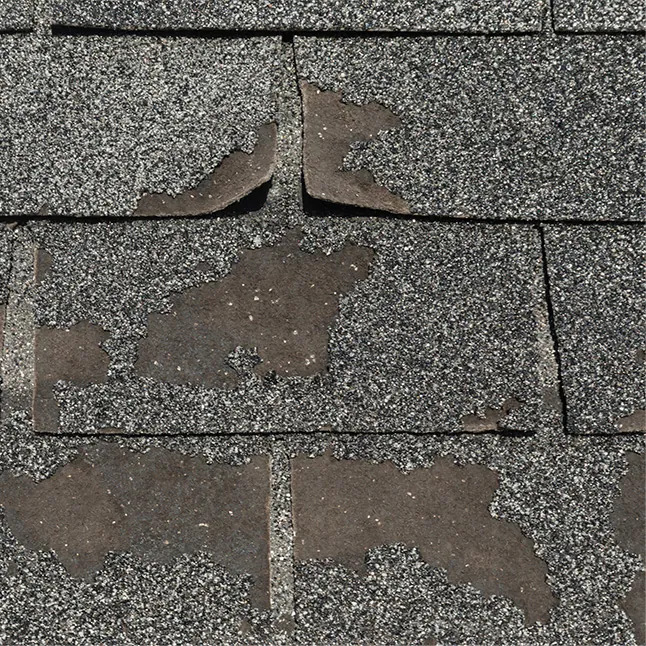
IBHS research suggests frequent small hail ages shingles faster too, by knocking off the granules that shield the asphalt from sunlight. See signs of hail damage for what to look for after a storm.
What shortens a roof's life
- Poor attic ventilation. ARMA lists premature roofing failure, buckled shingles and rotting wood among the results of poor ventilation. The 2021 International Residential Code calls for net free vent area of at least 1/150 of the vented attic space, or 1/300 when the vents are split between high and low as the code describes, and it requires that insulation not block the eave vents. Soffit vents are a common intake; see soffit and fascia.
- Sun and heat. Slope direction and shingle color change how fast asphalt ages, and an unshaded roof takes the full force of a St. Louis summer.
- Trees. ARMA warns that branches touching the roof scuff its surface, and that overhanging limbs add shade and drop debris that holds moisture, which invites moss.
- Poor installation. NAHB and InterNACHI both name installation among the main factors. Haag's engineers list nails not driven flush among common installation defects, and ARMA traces most buckled shingles to wrinkled underlayment or a deck that moves with moisture. The code requires shingles to go on according to the manufacturer's instructions, with at least four nails per strip shingle.
- Foot traffic and pressure washing. Walking on hot shingles can mar them, Haag notes, and ARMA warns that pressure washing causes granule loss and very likely premature failure.
What your neighborhood's build year tells you
The U.S. Census Bureau's American Community Survey reports the median year that homes in each place were built. Half the homes are older and half are newer, which makes the median a rough clock for a neighborhood's roofs. These figures come from the 2020 to 2024 survey.
| Place | Median year built | Age of that home in 2026 | What it suggests |
|---|---|---|---|
| Cottleville | 2012 | 14 years | Original roofs are mid-life, unless hail has already replaced them |
| Wentzville | 2008 | 18 years | Original 3-tab roofs are near the end; architectural roofs have years left |
| O'Fallon | 2000 | 26 years | Original asphalt roofs are at or past typical life |
| St. Peters | 1988 | 38 years | Original roofs are long past typical life; most homes have likely been reroofed |
| Florissant | 1963 | 63 years | Several roofs in; check layers and decking |
| Webster Groves | 1952 | 74 years | Several roofs in; check layers and decking |
The median describes the houses, not the roofs. A 1988 house in St. Peters may have a roof from last year, and a 2000 house in O'Fallon may still have its first. Hail resets the clock unevenly. On May 16, 2025, storms dropped hail of 2 to 2.5 inches on the region, with 30 reports in St. Charles County alone in NOAA's Storm Events Database, so two houses built the same year can now have roofs of very different ages.
St. Charles (median 1986) and Chesterfield (1982) sit in the same spot as St. Peters. In older suburbs like Webster Groves, Kirkwood (1962) and Florissant, the age of the house tells you little about the roof. What matters there is the current roof's age and how many layers are up there, since the 2021 International Residential Code does not allow a new roof over two or more existing layers.
Getting the full life out of your roof
You cannot change the weather, but you can control most of the rest:
- Look at the roof from the ground with binoculars each spring and after big storms, as ARMA suggests.
- Check the attic for stains, daylight or damp insulation after heavy rain.
- Keep gutters clear and branches trimmed back from the roof.
- Keep soffit vents open and insulation off them.
- Never pressure wash shingles, and stay off the roof.
Our roof maintenance checklist lays this out season by season. When it is time to weigh repair against replacement, signs you need a new roof covers how to tell when a roof is finished.
If you are not sure where your roof stands, a free inspection from Correll Roofing Co. comes with photos and a walk-through of what we found, with no obligation. Schedule a roof inspection or contact us.
- Standard Estimated Life Expectancy Chart for Homes, InterNACHI
- Study of Life Expectancy of Home Components (2007), National Association of Home Builders and Bank of America Home Equity
- Mastering Roof Inspections: Metal Roofs, Part 4, InterNACHI
- Mastering Roof Inspections: Metal Roofs, Part 8, InterNACHI
- Mastering Roof Inspections: Slate Roofs, Part 2, InterNACHI
- Mastering Roof Inspections: Slate Roofs, Part 5, InterNACHI
- Mastering Roof Inspections: Slate Roofs, Part 6, InterNACHI
- Mastering Roof Inspections: Attic Area Roof Inspection, InterNACHI
- Hail Damage Threshold Sizes for Common Roofing Materials, Haag Engineering (American Meteorological Society)
- Hail Damage to Asphalt Roof Shingles, Haag Engineering (American Meteorological Society, 2004)
- Summary of Monthly Normals 1991 to 2020, St. Louis Lambert International Airport, NOAA National Centers for Environmental Information
- Missouri State Climate Summary 2022, NOAA National Centers for Environmental Information
- Dealing with and preventing ice dams, University of Minnesota Extension
- Impact Testing of High Concentrations of Small Hail, Insurance Institute for Business and Home Safety
- Frequently Asked Questions, Asphalt Roofing Manufacturers Association
- Why Ventilation is Important, Asphalt Roofing Manufacturers Association
- Algae Discoloration of Roofs technical bulletin, Asphalt Roofing Manufacturers Association
- Algae and Moss Prevention and Cleaning for Asphalt Roofing Systems, Asphalt Roofing Manufacturers Association
- Plain Facts About Buckled Shingles, Asphalt Roofing Manufacturers Association
- Spring Roof Inspection a Must for Property Owners, Asphalt Roofing Manufacturers Association
- 2021 International Residential Code, Chapter 8 Roof-Ceiling Construction, International Code Council
- 2021 International Residential Code, Chapter 9 Roof Assemblies, International Code Council
- Median Year Structure Built (table B25035), American Community Survey 2020 to 2024, U.S. Census Bureau via Census Reporter
- NOAA Storm Events Database, NOAA National Centers for Environmental Information